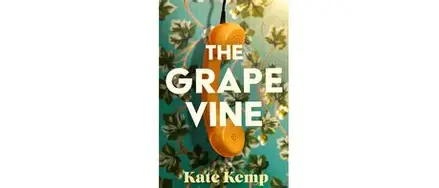
 About the book…
It’s the height of summer in Australia, 1979, and on a quiet suburban cul-de-sac a housewife is scrubbing the yellow and white checkered tiles of the bathroom floor. But all is not as it seems. For one thing, it’s 3am. For another, she is trying desperately to remove all traces of blood before they stain. Her husband seems remarkably calm, considering he has just murdered their neighbour.
As the sun rises on Warrah Place, news of Antonio Marietti’s death spreads like wildfire, gossip is exchanged in whispers and suspicion mounts. Twelve-year-old Tammy, an amateur observational scientist, is not alone in feeling determined to find out what happened.
There are secrets behind every closed door in the neighbourhood, and the identity of the murderer is only one of them . . .
Published by Phoenix on March 13th, I am so grateful to the publishers and Tracy Fenton of Compulsive Readers for the blogtour invite and gifted review copy of The Grapevine by Kate Kemp
This is, hands down, one of the finest books I have read this month, this year, of all time.
The nostalgia value is sky high, I don’t believe this tale could be told in a modern day setting, as the invention of the internet would completely strip away all interest, relevance, and intrigue into the disappearance of the 19-or was her 24?!-year old Antonio Marietti. The disappearance of his whole person , but the appearance of one of his feet in 1979 Canberra.
Opening scenes take a sharp twist down a dark and dingy alleyway as the aftermath of a potential crime scene is frantically cleaned, and someone leaves their home, trying to avoid being seen, with an unlikely accessory-a back pack.
Living in a cul de sac of 9 houses, with one way in and one way out, this creates a pressure cooker situation just at the same time that school breaks for the summer (this being Australia, it took a while for my brain to connect December being mentioned and summer, achingly described as a heavy prescence which lays over the grapevine, and grows the fruit of gossip until it becomes an over ripe fruit, much like the spoiled peaches in Naomi’s kitchen).
Tammy-never Tamara-is relentlessly bright and endearingly lonely, asking her teacher for a summer project and being pushed aside , told to have fun and clearly illustrating that her teacher neither knows, or understands her.
Tammy decides to take on a project of her own, creating a study on the behaviour of ants related to how they organise, move, attack, reproduce, and die, a microcosm of the neighbourhood around her where the houses stand fiercely independently yet always in view of each other.
Interspersed between the alternating perspectives of the chapters, you follow Tammy’s project which is actually just as interesting as the mystery itself which concerns not so much a ‘whodunnit’, but focuses instead on a cultural and psychologically devastating examination of a small town life.
They are exemplars of society at the time, coming from various different backgrounds and exhibiting opinions reflective of the times, including attitudes towards child bearing/rearing, women’s rights and culturally insensitive attitudes towards anyone identifying as ‘other’.
The ‘flatmates’ Ursula and Lydia. Immigrant Guangyu and her family straddling first, second and third generation women. Single mum with 3 kids by 3 different dads, Sheree. Joe and his wife Zlata, whose dialogue indicates they are not native to Canberra. Outsider , Debbie, sent to live with her aunt in order to escape a ‘secret shame’.
It’s like Peyton Place crossed with ‘Deadly Animals’ and seen through the lens of a country on the precipice of entering a new decade, marked with a violent death.
As characters note, ‘presumed dead’ is worse than ‘dead dead‘ because so much is left unsaid and unknown.
For Tammy, her summer is infinitely more complicated but interesting than she could have imagined, and her investigation is less about finding out what happened to Antonio, than dealing with who exactly she is.
”Tammy occupied that perilous, hope-ridden land between primary school and high school , her on-the -cusp body awkward and her on-the-cusp emotions confusing. Neither felt under her control anymore.’
As readers, we move around the different perspectives of the 9 houses, rooted in Tammy’s viewpoint even as you read what the other characters are going through.
It’s a mosaic that is pieced together under the piercing glare of the sun, oppressively heated by the season and cooked into a finale that is truly memorable.
The characters are terrifically defined where they could come across as stereotypes, the issues of the day are threaded through the narrative rather than yelling out ‘Look at what we had to put up with way back when!’
Except, when you think about it, we haven’t really advance that far as a society regarding the rights of those identified as ‘other’, those who make you feel a bit different, and bit uneasy because you cannot box them up.
I , however, can box this book in my all time favourite reads and cannot recommend it more highly than that.
 About the author…
Kate Kemp is an Australian writer living in the UK.
She trained as an occupational therapist and then as a systemic psychotherapist and has worked with families and individuals in mental health services in both Australia and the UK.
In 2021, she won the Stylist Prize for Feminist Fiction and the Yeovil Literary Prize.
The Grapevine is her first novel.
Instagram @kate.kemp.writer
Twitter @Tr4cyF3nt0n @Phoenix_Bks @kate_kemp
Author

bridgeman.lenny@gmail.com
Related posts
#BookReview ‘Strange Buildings’ by Uketsu trans by Jim Rion
About the book… From the bestselling author of ‘Strange Houses’ and ‘Strange Pictures’ comes a mesmerizing novel of eleven strange buildings and one terrible...
Read out all
#BlogTour ‘The Friend Of The Family’ by Dean Koontz
About the book… A girl liberated from a carnival sideshow discovers her mysterious purpose in a moving novel about family, sacrifice, and...
Read out all
#BlogTour ‘Return To Skull Island’ by Simon Furnam, Chris Jones and Inhyuk Lee
About the book… The official continuation of the hit Netflix series and set in the iconic Kong franchise, Return to Skull Island...
Read out all
#BookReview ‘Dying For Christmas’ by Tamar Cohen
About the book… I am missing. Held captive by a blue-eyed stranger. To mark the twelve days of Christmas, he gives me...
Read out all
#BookReview ‘Red 1-2-3’ by John Katzenbach
About the book… Three women. They have nothing in common. They are different ages, come from different background, and lead drastically different...
Read out all
#BlogTour ‘The Whisper Of Stars’ by Cristin Williams
About the book… A monastery turned political prison. A cipher inked in blood. When anarchist poet Katya Efremova is transferred to the...
Read out all