 About the book…
A tragic, unnamed engineer-turned-criminal is immersed in chemicals that disfigure him bizarrely, driving him mad and thus giving birth to the Joker.
While the insane criminal is imprisoned, Batman and Batgirl (Barbara Gordon) patrol Gotham City together, taking down perps such as the crime boss Maxie Zeus. Simultaneously Detective Harvey Bullock works with Commissioner James Gordon to take down a drug factory.
Back in Arkham Asylum, Joker learns of a new technology he wants to acquire and escapes, setting out on a mission designed to break the Commissioner, forcing him to abandon his ideals as a police officer. In a violent home invasion he shoots and cripples Barbara, then takes Gordon hostage.
Batman races to rescue Gordon, ultimately confronting his arch-foe in an amusement park fun house.
This edgy adaptation by Hard Case Crime novelist Christa Faust expands upon the cast and adds intricate layers to the events of the graphic novel, further examining the nature of morality.
‘The Killing Joke’ is one of Titan’s adaptations of classic comic book storylines, creating a new experience for the reader who may well be familiar with the original. Others include ‘Batman:The Court Of Owls’ and ‘Mad Love’ which is the origin story of Harley Quinn and Joker, reviewed here
And the stakes are even higher when you take a classic text like Alan Moore’s seminal classic. It is a pivotal moment in the history of the Batman , and the first thing which I noticed when I started reading, is the skill of writer Christa Faust in not using words to recreate the comic, square by square.
She reminds you that the Batman is a detective, something often pushed to the background in both movies and books. She uses her skills as a hardboiled crime writer to create a very dark, noir-ish atmosphere, and leaves you space to fill in the the gaps between what has has written, the visuals which Moore and Brian Bolland imprinted on the graphic novel reader, and what the legend of Batman brings with it.
Namely a nemesis-scratch the Batman, find the Joker. Their co-dependency reaches toxic, life threatening levels when he gets a little too close to where Bruce Wayne lives -spoiler, the alter ego of Batman is a millionaire playboy.
This time, he involves the Gordons, both the Chief Commissioner and his daughter, Barbara, are pawns in the Joker’s game.
A origin story, populated with cameos by Gotham’s dark and dangerous lunatics, a look at the back story of looming gothic nightmare, Arkham Asylum and its bones baked in blood, as well as the corrupt city of Gotham itself, served by criminals and law keepers alike. It is a dark and sleazy city which jumps off the page and reminds you that this is the setting which created both Batman and Joker-toxic fraternal twins from the same diseased mother.
It is no mean feat to write a novel which brings new insights into a story so deeply entwined in cultural significance,let us not forget that this is possibly one of the darkest tales in Batman’s back catalogue, except for ‘‘A Death In The Family’
It has ripples which forever alter the DC Universe, not only in presenting the back story of Joker as a man, a worker who wanted a family, a chemical plant worker with a young family. He dreams of being a stand up comedian until one day, events spiral out of control and show just how easy it is for those teetering on the edge to fall over into madness.
As he becomes more and more unreal, his previous persona disappears until there is only Mistah J, on a mission to create the worst day ever for the Batman.
Was he trying to push him into madness for punishment or pleasure, how knows, what is clear is just how much the Joker wants to teach Batman an unforgettable lesson, causing him to make choices he doesn’t want to, and do these against his very strict moral code.
The links between morality, responsibility and personal obligation to write wrongs are explored through life events, and opportunities presented to both men, whilst examining the psychological impact of why they became who they became.
With Commissioner Gordon trapped in a funfair, literally and figuratively in hell, Joker plays trick after trick to break him, convinced that if he can be broken, then anyone can.
An archetypal race against time for the Batman takes place against a stark background with very little light shining through.
What will happen when Batman and Joker face off, finally? Who wants revenge more ? And who has the more robust reasons for claiming their prize, or incarceration, annihilation, or insanity?
This is a fantastic novel, one for every reader who quietly said ‘awww…’ when they turn the final page of the graphic novel. It takes the core strengths of the original one shot and extends to novel length with nary a slip in the timeline, never missing a beat, or fleshing it out with extraneous details so that the reader does not think they have been hoodwinked by a money grabbing opportunity. This is for every reader who wanted more.
And we get it. Alongside the origin tale, we get new plotlines relating to Barbara Gordon and her role as Batgirl, which constantly puts her in danger as well as Bruce and Jim Gordon at logger heads. The joke is that in order for her to fulfil her true potential, and be seen by her father, Barbara has to first walk through hell.
It does a remarkable job in transferring the pivotal story of the Joker into from one art form, to another, which then urges you to go back to Moore and Bolland’s version.
And you know what?
Anything which has me spending longer periods in Gotham City and it’s dark, shadowy enclaves is absolutely alright for this reader!
 About the authors…
Christa Faust is an American author who writes original novels, as well as novelizations and media tie-ins.
Links-http://www.christafaust.com/
Twitter @faustfatale @TitanBooks
 Gary Phillips lives in Los Angeles and is best known for his novels and short stories featuring PI Ivan Monk. He has worked a lot of different gigs in his time: a graveyard shift security guard, a printer, a union organizer, co-director of the MultiCultural Collaborative (a nonprofit set-up to improve race relations after the ’92 LA riots) and as political director of a city council campaign.
He writes on politics and pop culture for such as the Los Angeles Times, LA Watts Times, Rap Pages, the San Francisco Examiner Examiner, Freestyle and Black Scholar. He occasionally loses money at the poker table, watches his kids play sports, and finds that walking the dog is a fine excuse to light up a stogie
Links-http://www.gdphillips.com/
Author

bridgeman.lenny@gmail.com
Related posts
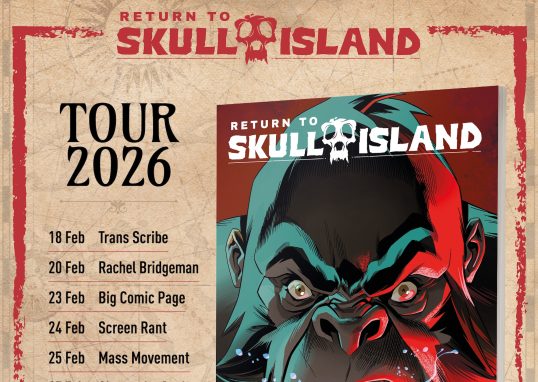
#BlogTour ‘Return To Skull Island’ by Simon Furnam, Chris Jones and Inhyuk Lee
About the book… The official continuation of the hit Netflix series and set in the iconic Kong franchise, Return to Skull Island...
Read out all
#BookReview ‘Lenore’ by Roman Dirge
About the book… Roman Dirge’s cute little dead girl, Lenore, faces off against the legendary Time Goats in the G.O.A.T. fight of...
Read out all
#BookReview ‘Kraken’ by Shannon Eric Denton and David Hartman
About the book… More monster than man… A unique supernatural historical adventure from the award-winning writer and artist team of Shannon Eric...
Read out all
#BookReview ‘Minky Woodcock-The Girl Called Cthulhu’ by Cynthia Von Buhler
About the book… The plucky detective returns in her thrilling third graphic novel, this time with an occult horror twist! Sensational artist...
Read out all
#BookReview ‘Dying For Christmas’ by Tamar Cohen
About the book… I am missing. Held captive by a blue-eyed stranger. To mark the twelve days of Christmas, he gives me...
Read out all
#BookReview ‘The Night Watcher’ by Tariq Ashkanani
About the book… In this tense thriller from the winner of the Bloody Scotland Debut Prize, PI Callie Munro is hunting a...
Read out all