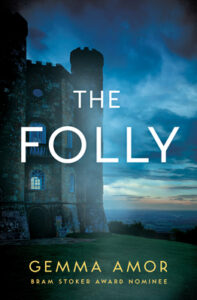
About the book…
 From Bram Stoker and British Fantasy Award-nominated author Gemma Amor comes an atmospheric gothic mystery that will haunt you long after the final page is turned.
Morgan always knew her father, Owen, never murdered her mother, and has spent the last six years campaigning for his release from prison. Finally he is set free, but they can no longer live in the house that was last decorated by her mother’s blood. Salvation comes in the form of a tall, dark and notorious decorative granite tower on the Cornish coastline known only as The Folly. It’s an offer too good to refuse.
At first the Folly is idyllic, but soon a stranger arrives who acts like Morgan’s mother, talks like her mother, and wears her dead mother’s clothes. Is this stranger hell-bent on vengeance, in touch with her restless mother’s spirit itself, or simply just deranged? And, most importantly, what exactly happened the night Morgan’s mother died?
An atmospheric nod to The Lighthouse, with hints of Du Maurier’s Rebecca, played out on a lonely, Cornish backdrop, ‘The Folly’ is visceral mystery and family drama, a dark examination of love, loyalty, guilt and possession that draws on the very real horror of betrayal by those closest to us, by those we love the best.
My thanks to the wonderful team at Datura Books who kindly sent me a copy of the paperback release of ‘The Folly’, which I excitedly put somewhere safe and promptly lost until I found it again last week and settled down to read it, before it vanished again.
I say settle, advisedly, as there is little which is ‘settling’ about any of this story at all. It remains a source of amazement to me how authors manage to pack so many features into a novella and leave the reader feeling like they have read a sweeping epic, whilst other authors spend 500 pages saying nothing meaningful at all.
Gemma Amor is a fantatstic writer, I first came across her work when I was sent a copy of ‘Dear Laura’ as a part of my Abominable Book Club subscription-review here– so I was hooked by the premise, the idea of a folly , the isolation which so many of us seem to crave but in reality, cannot cope with.
Set against the background of the pandemic, Morgan is the narrator giving you an intimacy into her thoughts and feelings as she waits for her dad to be released from prison, after successfully appealing his murder sentence for the death of her mother.
The conflict is intense and immediate, here is a woman whose prime years-as decided by a society which values women’s childbearing capabilities-have been paused. She has been mired in the grief for her mother but not allowed to move on due to the charge that her father was responsible for the fall down the stairs which led to her death.
From one prison to another, Owen has spent 6 years behind bars with very limited space or personal freedom so emerging into a world which has, in the words of Stephen King, ‘moved on’ is extremely unsettling. This is doubly so when the pandemic is being referred to as ‘in the past’ whilst many of us still live with the trauma,after effects and despair which touched so many lives.
Still living in the house where she grew up, Morgan has made the executive decision for them both to move to Cornwall and become caretakers of a Folly.
Literally a building with no purpose or meaning and built in a circular fashion so even the rooms and floors are deliberately nonsensical, the remote location and lack of attention to a recently released prisoner can afford them time to heal out of the public eye.
You really begin to realise just what strength Morgan has to have remained in the house, walking up and down the stairs past the spot where her mother’s body lay, broken and twisted, whilst maintaining a campaign to free her dad.
The Folly is a perfect allegory of their situation and life and the perfect location for them to retreat to, even though it has a dark and disturbing history of its own where fact and fiction meld into a netherworld of folklore, myth and whispered tales .
The small details of what Morgan remembers about her mum are woven through the narrative so when a stranger appears from seemingly nowhere, using her mother’s voice, her catchphrases and even her gestures, this appears like targeted harassment against Owen and Morgan.
If only it were that simple….
As the Folly moves from being a haven to the eye of a storm wreaking perceived vengeance, the reader is pulled deeply into a tale of loss, grief, sense of obligation based on blood relation, and distorted reality.
Morgan’s voice as a narrator -is it a reliable one?
Are her memories really what she has framed them as or is it the reluctance of a daughter to truly believe what her own dad is capable of ?
Deeply unnerving and so very moving, this is a story of a haunting place, lived in by haunted people. They think by leaving the place where Morgan has existed in a state of self inflicted punishment for so long, that dues are paid and debts settled. But the Folly? Well it has other ideas…
About the author…
 I’m a horror fiction author, podcaster, artist and voice actor from Bristol, in the U.K.
I write for the wildly popular NoSleep Podcast and various other horror fiction audio dramas. I’m also writing, producing and acting in two shows, ‘Calling Darkness’, and ‘Whisper Ridge’, out in 2019. My first anthology of short stories, ‘Cruel Works of Nature’, was released in 2018, and my next book is the novella ‘Collection’.
I’m heavily influenced by classical literature, gothic romance and magic realism. I am most at home inside a dusty, rundown mansion or in front of a fire with a single malt and a dog-eared copy of anything by Angela Carter.
Links-https://gemmaamorauthor.com/
Twitter @manylittlewords @DaturaBooks
Author

bridgeman.lenny@gmail.com
Related posts

#BlogTour ‘Bitter Sweet’ by Hattie Williams
About the book… ‘In my life, there are things that have happened to me, and things that I have done, that have...

#BookReview ‘One Dark Summer’ by Saskia Sarginson
About the book… The BRAND NEW psychological thriller from Richard and Judy bestselling author of The Twins, Saskia Sarginson It was the...
Read out all
#BookReview ‘Come Knocking’ by Mike Bockoven
About the book… In a groundbreaking theatrical experience gone horribly wrong, a deadly night reveals the dark consequences of blurring the lines...
#BookReview ‘The Locked Door’ by Freida McFadden
About the book… Some doors are locked for a reason… While eleven-year-old Nora Davis was up in her bedroom doing homework, she...
Read out all#CoverReveal ‘Coffin Moon’ by Keith Rosson
Another day, another FABULOUS book reveal (hopefully on the right day at the right time, she says, fingers crossed she is living...
Read out all#CoverReveal ‘The People Next Door’ by Kate Braithwaite
Arghhh! So many apologies I have no idea what day it is but does it feel to you like February is going...