About the book…
 The Norwegian Anne Tyler makes her English debut in a beautiful, bittersweet novel of regret, relationships and rare psychological insights…
`There is a hint of Ingmar Bergman in this portrayal of a completely normal family, it delves deep and wrenches your heart’ Adresseavisen
When Liv, Ellen and Hakon, along with their partners and children, arrive in Rome to celebrate their father’s seventieth birthday, a quiet earthquake occurs: their parents have decided to divorce.
Shocked and disbelieving, the siblings try to come to terms with their parents’ decision as it echoes through the homes they have built for themselves, and forces them to reconstruct the shared narrative of their childhood and family history.
A bittersweet novel of regret, relationships and rare psychological insights, ‘A Modern Family’ encourages us to look at the people closest to us a little more carefully, and ultimately reveals that it’s never too late for change…
Beginning with a trip to Italy, the family at the centre of this novel are defined by the way they sit on the airplane and interact-or don’t-with each other. Split into three first person narratives , the three grownup children of Sverre and Torrill, who are Ellen,Liv and Hakon are travelling together to celebrate the 70th birthday of their father,with spouses and children in tow.
The story starts with first person narrator, Ellen,wife of Olaf .Olaf has arranged for them to stay in his brother’s house to share control over the success/failure of this trip with his father-in-law.In this stage setting first act, the reader begins to see her internal dialogue and perspectives on the inter family realtionships.
‘It’s hard, if not impossible, to talk about Dad without mentioning you, Mum,’ I say, looking at her. ‘Even though you are two very different individuals, you are a unit in our eyes, and each other’s. The way you complement one another, the way you cooperate, the way you demonstrate the values of respect and love – all while giving each other necessary space – is something that I’ve always strived for in my own marriage,’ I say, and Olaf laughs.
‘Some might suggest I’ve tried to follow your example with a little too much gusto,’ I add, improvising slightly and smiling at Olaf. ‘But still, the two of you are a formidable act to follow. It is said that women choose men who remind them of their fathers, often with a certain degree of irony, but I can honestly say that I have sought – and found – a man like you, Dad, because for me you represent the very best there is, in every way imaginable.’
With this as a role model, the scene is set-has Liv,indeed, married her father and set herself an impossible task of living up to her parent’s image? Is this why her mother and sister constantly chide and jibe at her ways of childraising, implying she is too much of a control freak to let her children breathe?
Moving on from this tightly wound Liv comes Ellen,, a speech writer by trade, in a relationship with Simen, and in the throes of trying to start a family. Her part of the novel is controlled by her reactions to the announcement that their parents make at the family meal on their first night in Italy. Drunk,disappointed and fed up, she provides a neat counterpoint to Ellen in her steadfast relationship, much more controlled by her emotions than her sister.
‘We’re lying in our new bed in the evening ,a week and a half before the planned trip to the cabin.We’ve been having sex practically without touching one another at all,entirely without passion or romance.Neither of us can face the prospect of pretending it’s anything other than a purely technical act at this point,we say nothing, making no acknowledgements or assurances,sharing no laughter.We are silent and focussed. Tomorrow it will be one week since we embarked on an entire year of attempts and I remember that night in our old flat,the old bed,the fierce lust and delight that was released by the same desire that now kills those sensations.’
In Ellen we see how desperately the need to create life, to make a family of your own came become a destructive act borne out of duty rather than love. The societal pressures, both internal and external equate having children with success.
The third and final part belongs to sole male sibling, Hakon.
‘I viewed my sisters with scepticism, happy that I neither had, nor ever would,end up living the way they did.Liv and Olaf, like an unalterable unit,a shared, irreversible life sentence. Or Ellen’s eternal search for Mr Right,the one to give his all ,and be everything for her.’
He sees his sisters not as role models, rather as experiemtns in life to be avoided whilst ignoring an intrinsic part of him which yearns for the attention of a woman,longs for their thoughts to be full of him.It is almost as if his true self is at odds with the image he wants to project.
This tightly knit, insular family unit is totally rocked to its foundation by the revelation of a divorce. The solid bedrock of Torvill and Sverre has come to an end, they feel that their children are old enough to acceot their wishes and adapt accordingly.
What they do not account for, however, is that their long and fruitful marriage has created an illusion in all of their children’s minds of how life should be lived. And the modern freedom of being able to access a divorce has meant this family relationship was both trapping and constraining them. They have an option, to split whist there is time to enjoy the rest of their lives. The ricochet effect, however, of this divorce has ramifications on all three children and ripples through their relatinships as well as their understanding of the world.
It’s a superbly constructed character study and a portrait of family life, expectations and liberations. Within these pages an intense and yet quiet examination is undertaken of a modern, normal family. It is as if the author has taken great pains to set the stage-the family holiday-and then place her carefully constructed characters just so,and let them loose to say what is in their hearts.
There is a dignity to the words and story that I am finding difficult to adeqately express my admiration for, an economy of words for which Rosie Hedger deserves so much credit, her translation brings to life Helga’s words and allows us to read Helga’s vision with aplomb. As usual , Orenda have excelled in matching writer and translator and added to their canon of translated fiction.
About the author….
 Helga Flatland is already one of Norway’s most awarded and widely read
authors. Born in Telemark, Norway, in 1984, she made her literary debut
in 2010 with the novel ‘Stay If You Can, Leave If You Must’, for which she
was awarded the Tarjei Vesaas’ First Book Prize.
She has written four novels and a children’s book and has won several
other literary awards.
Her fifth novel, ‘A Modern Family’, was published to
wide acclaim in Norway in August 2017, and was a number-one bestseller.
The rights have subsequently been sold across Europe and the novel has sold more than 100,000 copies.
Links-http://orendabooks.co.uk/
http://randomthingsthroughmyletterbox.blogspot.com/p/services-to-publishers-authors-blog.html
Author

bridgeman.lenny@gmail.com
Related posts

#BlogTour ‘Bitter Sweet’ by Hattie Williams
About the book… ‘In my life, there are things that have happened to me, and things that I have done, that have...

#BookReview ‘Mahattan Down’ by Michael Cordy
About the book… A propulsive rollercoaster high concept international thriller which dares to take the world to the edge of oblivion. THE...
Read out all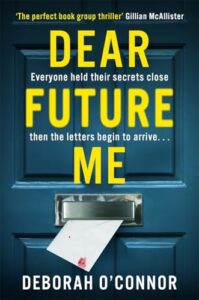
#BlogTour ‘Dear Future Me’ by Deborah O’Connor
About the book… In 2003 Mr. Danler’s high school class got an assignment to write letters to their future selves. Twenty...
Read out all
#BlogTour ‘The Strange Case Of Jane O’ by Karen Thompson Walker
About the book… In this spellbinding novel, a young mother is struck by a mysterious psychological affliction that illuminates the eerie dimensions...
Read out all#BlogTour ‘The Grapevine’ by Kate Kemp
About the book… It’s the height of summer in Australia, 1979, and on a quiet suburban cul-de-sac a housewife is scrubbing the...
Read out all#BlogTour ‘The Swell’ by Kat Gordon
About the book… In places of darkness, women will rise . . . Iceland, 1910. In the middle of a severe storm...
Read out all